By the 31st century, the modern-day concepts of child-fingerprinting and RFID tags has morphed into the Public Service, a technology that allows parents to genecode their kids so that they can be located at all times, eavesdropped on with ease, and even “programmed” to find junk food and other “bad things” physically nauseating. I wish this were a more implausible concept, frankly, but that’s undeniably the direction our civilization is headed.
The Legionnaires find this abhorrent. They wear Flight Rings that not only allow them to defy gravity but also cloak them from the Public Service. They fight for the freedom of underagers galaxywide--and they do so using long-forgotten methods of conduct. Barry and I think of them as the Society for Creative Anachronism of the 31st century: they know that Earth used to be overrun with “super-heroes”--dynamic figures in skin-tight, ostentatious costumes--and that becomes their fashion statement when they hang out.
“They’re ‘hanging out’?” scream the adults. “With no PURPOSE? How positively...UNCOUTH!”
Frowned upon? Oh, yeah. The adults, in their drab and bilious clothing, with their remote nature and complex rules for social interaction, think what they’re doing is tacky and gauche and inappropriate. So much the better. Makes it more attractive. The Legion of Super-Heroes is out to right wrongs, make noise, and leave their mark. The Legion is more than a club, more than a police force. It’s a movement, and that’s what we hang our series on. Their philosophy is on the splash page of every issue.
Thursday, October 06, 2005
Geek post
Mark Waid makes the Legion of Superheroes sound interesting, via Newsarama:


Sakuraba-Shamrock Among Matches Announced for Oct. PRIDE
Interesting matchup. As always, I'm pulling for Sakuraba. Looks to be a good card...
Via Sherdog:
Via Sherdog:
Newly announced matches include PRIDE mainstay Kazushi Sakuraba taking on veteran mixed martial artist Ken Shamrock...
Sakuraba returns to action for the first time since his savage beating at the hands of Ricardo Arona in the recently concluded PRIDE Middleweight Grand Prix. Though there was talk of retirement for the 37-year-old Sakuraba, it's clear he never seriously considered leaving the fight game. The same could be said for Shamrock, 41, a veteran of MMA since before the sport was introduced to the U.S. in 1993. His last appearance in the ring was short, as current UFC middleweight champion Rich Franklin stopped him with strikes last April.
Fight card:
Mirko Filipovic vs. Josh Barnett
Kazushi Sakuraba vs. Ken Shamrock
Sergei Kharitonov vs. Fabricio Werdum
Quinton Jackson vs. Hirotaka Yokoi
Murilo Rua vs. Murad Chunkaiev
Henry Miller vs. Zuluzinho
Makoto Takimoto vs. Yoon Dong Sik
For Kathy and Sandy...
Via instructables:
go anywhere disposable scrabble game.
go anywhere disposable scrabble game.
here's a scrabble board that conveniently prints on an A4 or lettter sized sheet of paper. if you are ever stuck on a plane or in a pub with no scrabble board you can use this sheet to get your fix.
Collapsing the Walls of Reality
Via Key23:
Viewing language as a binding agent of reality, it only takes one further step to realize that the language one possesses forms a border of reality. In a culture that communicates primarily thru written words, alphanumerical symbols comprise a frontier of the imaginable. What one does not possess words for, one cannot intelligently articulate in the local symbol system. Concepts exist, but beyond an accessible border. The Burroughsian concept of language as virus seems particularly illustrative in this regard. The rapid self-replication of such recently created language memes such as ‘war on terror’, ‘9/11’, ‘abortion isn’t birth control’, ‘intelligent design’ and (perhaps most dangerous) ‘reality’ as a misnomer for the consensus reality offered to middle America by mass media stand as striking evidence of the malleability of one’s personal reality thru language. On September 10, 2001 the term ‘war on terror’ would make about as much sense as ‘war on anger.’ Yet a mere four years after the attack on the WTC and Pentagon nearly everyone in the western world has a grasp of what ‘war on terror’ means. Indeed, some pundits even suggested that this linguistic construction helped the Texas Taliban coast thru to their second term of office by consciously avoiding use of the word ‘Iraq.’
Politics, however, seems only to codify things already thoroughly sold to the masses in the ideasphere of Yesod. While I count myself in the camp of those who do not consider America a democratic republic anymore of even the most rank variety, the people still need reassurance. All but the most naked and brutal domestic police states have ruled effectively without at least the tacit apathetic consent of their people. Analysts and critics have written endlessly about the effect of the mass media on shaping popular opinion as relates to politics. I suggest that the explorations have not gone far enough. Dr. Terrence McKenna explores the idea of television as a drug in his classic social history of chemical induced brain change Food of the Gods. He also posits the view that language doesn’t operate as a reflection of reality but rather that (as far as such Aristotelian maxims work) language is reality. Pairing these ideas one sees a grimmer picture of television media than posited by post-Chomskyan media theory. Television operates as a drug that sedates the body and dulls the senses while simultaneously feeding memetic poison into the human brain. Perhaps most terrifying, all this information gets fed into the human brain under the guise of ‘reality.’
‘Reality’ television seems to have accelerated the project beyond the wildest dreams of even the wiliest television executive. Americans describe the heavily stylized events of a reality television series as if they actually represent the reality recorded by the camera and the reality of the lives of the ‘stars.’ They see in reality television a way to relate to the montage of images and sound presented before them. Particularly for the younger generation this inundation of images hooks deep into the psyche. Increasingly people see themselves as stars of their own little reality series, formerly known as ‘life’ with their own internal monologue (or personal desocialization device- iPod, Discman, &c.) supplying soundtrack, their recollections providing a seamless edit of reality into discrete bundles of time- episodes, seasons and so on.
The omnipresence of surveillance does little to downplay the idea of ‘every man and woman a (television) star.’ The phenomenological process of television- the recording of framed events onto magnetic tape, available for further playback and editing- has all but blanketed the urban centers of the United Kingdom and under the auspices of Department of Homeland Security grants now creeps out of gas stations and banks and onto highways in America. What role does reality television play in increasing the acceptability of such phenomenon? Clearly, a feedback dialectic exists on this front. Westerners enjoy the sensations resulting from acting as a subject of voyeurism. Simultaneously, the observation of the dreary events that bleed together to form their little lives provides a sense of reassurance- yr important enough to watch. Cameras pop up more numerous than rose gardens in the mallscape becoming like the classic water to a fish. Still, it seems impossible to accept that the saturation of public space with surveillance has little effect on public behavior. Besides the most obvious feeling generated- paranoia- the reality show effect kicks into hyperdrive. Many have rightly observed that when looking down the barrel of a camera, ‘real’ seems about the least appropriate word to describe human behavior (leaving aside questions of just what ‘real’ ‘is’ for now).
Attention
Our world contains both beauty and ugliness, kindness and cruelty. The question is, where shall we fix our attention?- Dan Millman
...If we view the world through the filter of our ideals, it will never measure up. Consider the influence of expectations on perception in the following anecdote: “A farmer was missing an ax from his tool shed. He suspected his neighbor’s young son. The boy looked like a thief, acted like a thief, and spoke like a thief. When the man eventually found his misplaced ax, his neighbor’s son looked, acted, and spoke like any other young boy.”
The fact that shadows exist, in the world and in ourselves, should not blind us to the light.
...There’s a story about a cancer-ridden football player who lay in a hospital bed, managing a smile as his coach entered the room and asked how he was doing. “Okay, I guess,” the player replied. But his sunken eyes told a different story.
After a long pause, the coach leaned close to the player’s face. “Listen, Mike. I need you at training camp in July, on the field, ready to go. We’re going all the way this year.”
Mike Westhoff, now recovered from bone cancer, is the special teams coach for the Miami Dolphins. He says of Coach Don Shula: “He treated me the way I could be, not the way I was. It made a difference.”
Hardship is part of life—but whether we view it as tragic or heroic, grotesque or purposeful, depends on our perspective. Our mind can make meaning or madness, light a candle or curse the darkness. The choice is ours. We can’t heal the world’s suffering—only our own. Accept life on its own terms. If we want a kinder world, then let us behave with kindness; if we want a peaceful world, let us make peace within. Our suffering serves no one. By letting go of our expectations, we liberate our lives.
Zen Wisdom [Really...]
Moments unfold, things happen.- Dan Millman
Our mind then creates meanings,
positive or negative,
about what happens.
Mistaking our meanings for truth,
we see things not as they are,
but as we are.
Viewing the world through windows
of interpretations and expectations,
our mind creates a drama, a comedy,
a tragedy, a romance, or a soap opera
out of what simply arises.
Thus, our expectations create our reality;
our mind creates our dreams and dramas;
and stress appears as the mind resists what is.
To attain freedom,
make peace with Mystery,
Lose your mind and come to your senses.
To reinvent your world,
shift your expectations,
then act without assumptions.
Reality is not what we think.
Zen Wisdom
Do not walk behind me, for I may not lead.
Do not walk ahead of me, for I may not follow.
Do not walk beside me either.
In fact, just leave me alone.
Do not walk ahead of me, for I may not follow.
Do not walk beside me either.
In fact, just leave me alone.
Wednesday, October 05, 2005
Scientists teach dolphins to sing Batman theme song; still no cure for cancer.
Dolphins sing 'Batman' theme
Jennifer Viegas
Discovery News
Monday, 3 October 2005
Scientists have taught dolphins to combine both rhythm and vocalisations to produce music, resulting in an extremely high-pitched, short version of the Batman theme song...
The Christian Virus
They're everywhere these people, I swear to god.
Okay, they're probably not really Amish at this little shop down the street from the house. I'd lay odds they've simply appropriated the english word "Amish" to invoke the homemade-old-timey-woodworking folksiness that it's thought to represent.
The most confusing thing to do in Japan is to take any of the English you read here literally.
Though speaking of christians, memetics, viruses and Japan, nothing can compare to - and I kid you not, this is a true story - the Japanese Jehovah's Witnesses who came to our door on Christmas Eve when we lived in Fukuma last.
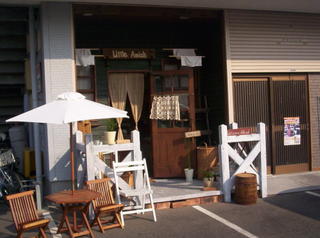
Okay, they're probably not really Amish at this little shop down the street from the house. I'd lay odds they've simply appropriated the english word "Amish" to invoke the homemade-old-timey-woodworking folksiness that it's thought to represent.
The most confusing thing to do in Japan is to take any of the English you read here literally.
Though speaking of christians, memetics, viruses and Japan, nothing can compare to - and I kid you not, this is a true story - the Japanese Jehovah's Witnesses who came to our door on Christmas Eve when we lived in Fukuma last.

A present from Shoda-sensei
Ah, training... Now I remember how all the little injuries start piling up...
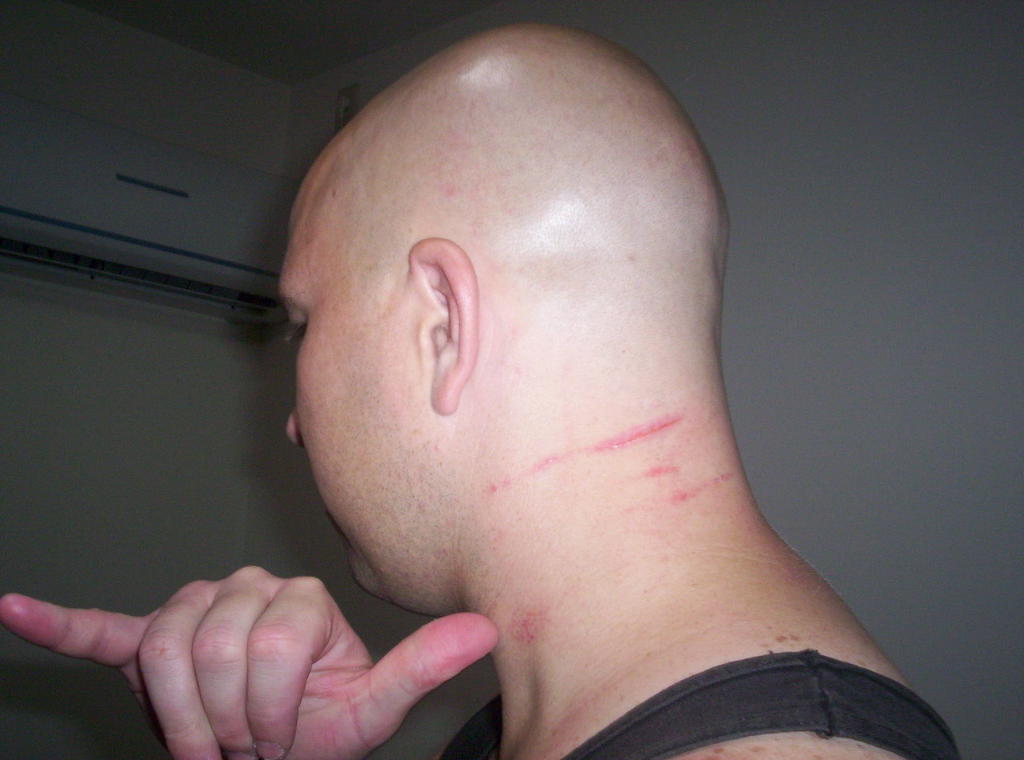
Tweaked my neck a bit by, um, well, landing on my head. Never actually a good thing. Full range of motion not quite back yet. Shins are banged and bruised up a little, despite shinguards. Tatsuya hit me so hard once in sparring that my jaw hurt two days later. Seriously.
And I got this little present from Shoda-sensei, who quickly apologized. Always remember kids and kiddettes, long nails and grappling don't mix.
Good times...

Tweaked my neck a bit by, um, well, landing on my head. Never actually a good thing. Full range of motion not quite back yet. Shins are banged and bruised up a little, despite shinguards. Tatsuya hit me so hard once in sparring that my jaw hurt two days later. Seriously.
And I got this little present from Shoda-sensei, who quickly apologized. Always remember kids and kiddettes, long nails and grappling don't mix.
Good times...
Going back to Cali, Cali, Cali... ummm, I mean Fukuma...
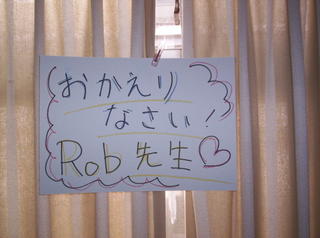
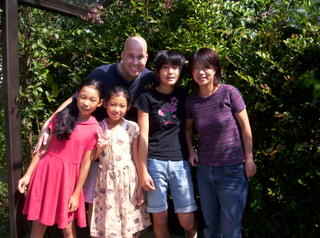
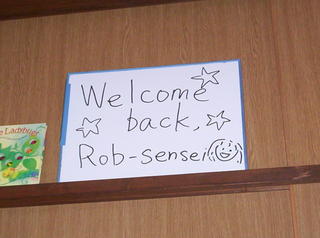
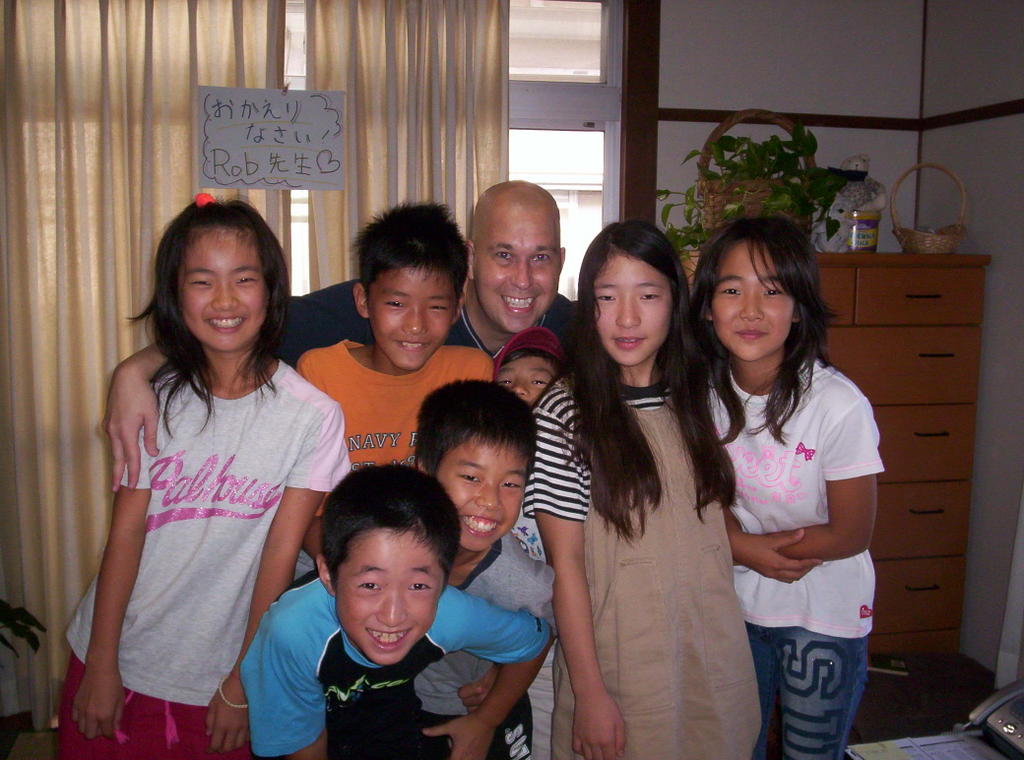
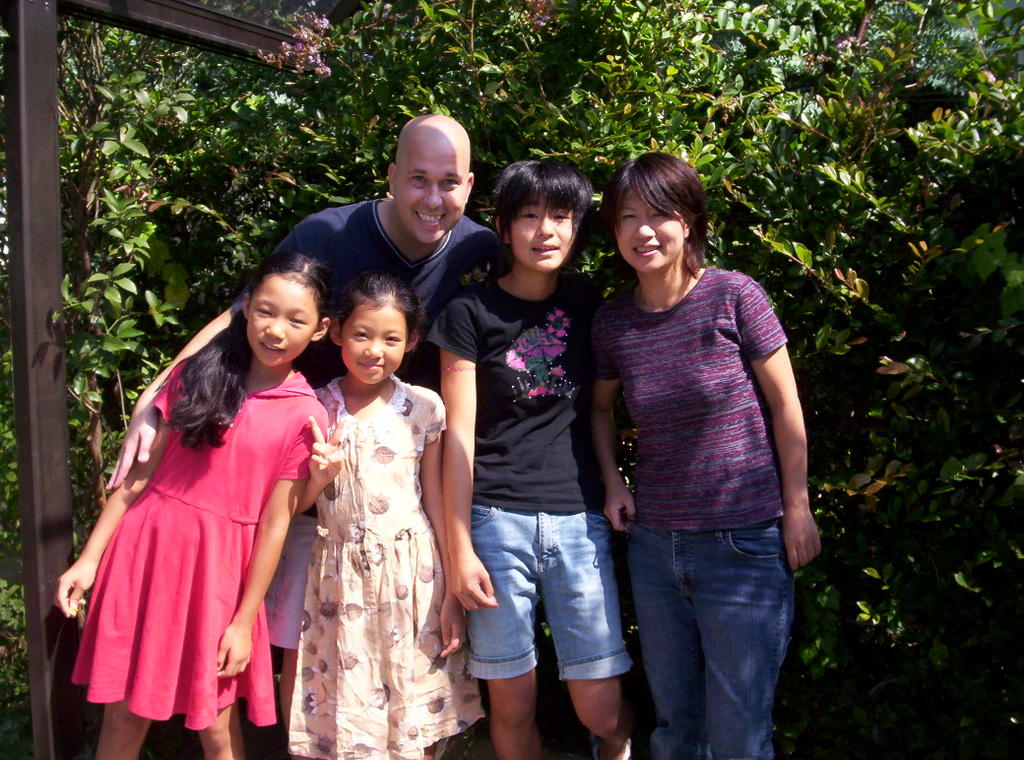
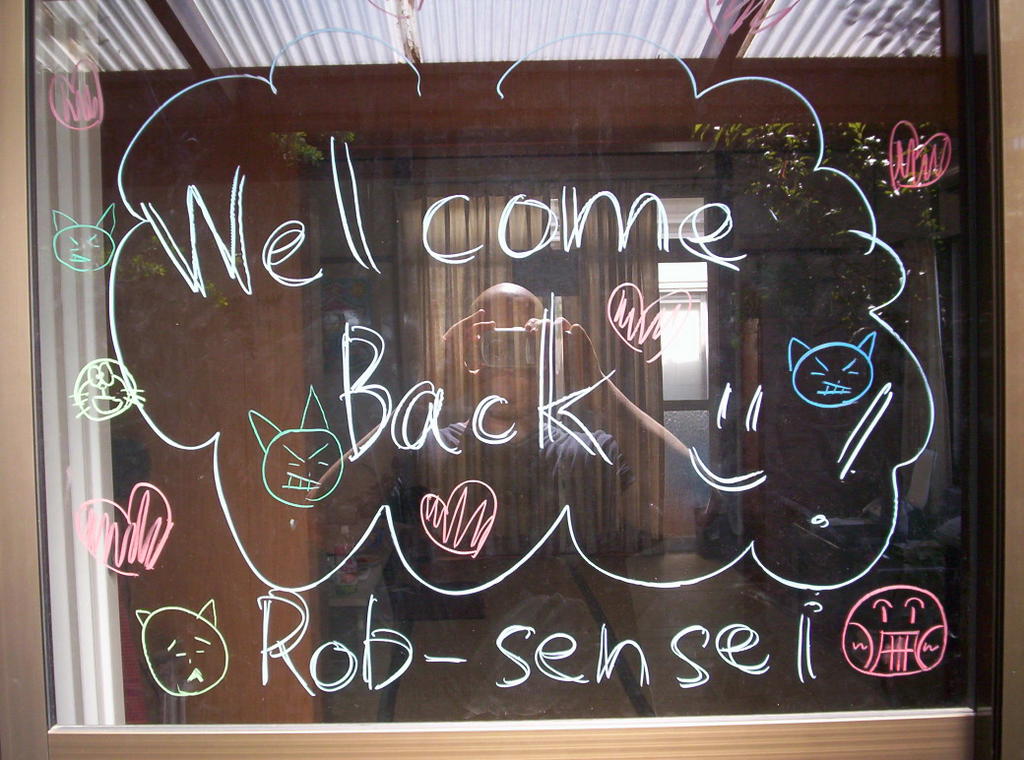
Went this past weekend to visit with/at the school I used to help out on occasion when Sandy and I lived here in Fukuma four years ago. The kids have all gotten very, very big... which made me feel very, very old :) Some pics...



Tuesday, October 04, 2005
Alohana
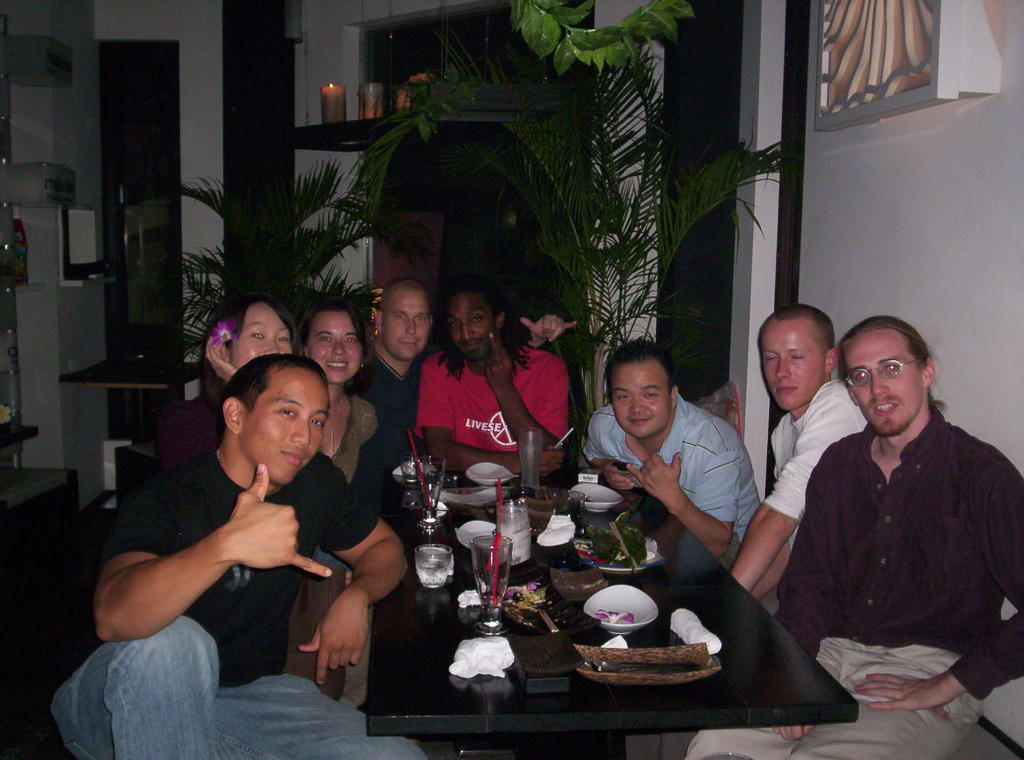
Malik set up a get-together for the Fukutsu/Koga/Block 13 JET's at Alohana restaurant in the city... alcohol was consumed and a good time was - seemingly - had by all. Can't even say how cool it is to find a Hawaiian style restaurant here in Japan. Poke, plate lunch, loco moco, mahi-mahi... mmmmm, good. It's no Sam Choy's, but it's my favorite-y restaurant goodness these days...
"This world makes it easy to toe the line, and easy to totally fuck up, and really hard to not do either one."
How to Drop Out
by Ran Prieur
by Ran Prieur
...Unlike many outsiders and "radicals," I never had to go through a stage where I realized that our whole society is insane -- I've known that as long as I can remember. But even being already mentally outside the system, I found it extremely challenging to get out physically.
...Getting free of the system is more complex than we've been led to believe. Here as in so many places, our thinking has been warped by all-or-nothingism, by the Hollywood myth of the sudden overwhelming victory: Quit your corporate job this minute, sell all your possessions, and hop a freight train to a straw bale house in the mountains where you'll grow all your own food and run with the wolves! In reality, between the extremes there's a whole dropout universe, and no need to hurry.
In my case, as I understood what I had to go through to make money, I stopped spending it. I learned to make my meals from scratch, and then from cheaper scratch, making my own sourdough bread and tortillas. I stopped buying music and books (exceptions in exceptional cases) and got in the habit of using the library. When I crashed my car, I kept the insurance money and walked, and then got an old road bike. I took a road trip by hitchhiking, but it was too physically taxing and I got sick. Like many novice radicals, I got puritanical and pushed myself too hard, and finally eased off. I temporarily owned another car and lived in it for a couple months of a long road trip. In the Clinton economic bubble, I got a job that was much easier and better paying than my previous jobs, and built up savings that I'm still living on.
The main thing I was doing during those years was de-institutionalizing myself, learning to navigate the hours of the day and the thoughts in my head with no teacher or boss telling me what to do. I had to learn to relax without getting lethargic, to never put off washing the dishes, to balance the needs of the present and the future, to have spontaneous fun but avoid addiction, to be intuitive, to notice other people, to make big and small decisions. I went through mild depression and severe fatigue and embarrassing obsessions and strange diets and simplistic new age thinking. It's a long and ugly road, and most of us have to walk it, or something like it, to begin to be free.
A friend says, "This world makes it easy to toe the line, and easy to totally fuck up, and really hard to not do either one." But this hard skill, not quitting your job or moving to the woods or reducing consumption or doing art all day, is the essence of dropping out. When people rush it, and try to take shortcuts, they slide into addiction or debt or depression or shattered utopian communities, and then go back to toeing the line.
The path is different for everyone. Maybe you're already intuitive and decisive and know how to have fun, but you don't know how to manage money or stay grounded. Maybe you're using wealth or position or charm to keep from having to relate to people as equals, or you're keeping constantly busy to avoid facing something lurking in the stillness. Whatever weaknesses keep you dependent on the system, you have to take care of them before you break away from the system, just as you have to learn to swim before you escape a ship. How? By going out and back, a little farther each time, with persistence and patience, until you reach the skill and distance that feels right.
...Some of the happiest people I know have dropped out only a short distance. They still live in the city and have jobs and pay rent, but they've done something more mentally difficult -- and mentally liberating -- than moving to some isolated farm. They have become permanently content with no-responsibility slack jobs, low-status, modest-paying, easy jobs that they don't have to think about at home or even half the time when they're at work. Yes, these jobs are getting scarce, but they're still a thousand times more plentiful than the kind of job that miserable people cannot give up longing for -- where you make a living doing something so personally meaningful that you would do it for free.
"Do what you love and the money will follow" is an irresponsible lie, a denial of the deep opposition between money and love. The real rule is: "If you're doing what you love, you won't care if you never make a cent from it, because that's what love means -- but you still need money!" So what I recommend, as the second element of dropping out, is coldly severing your love from your income. One part of your life is to make only as much money as you need with as little stress as possible, and a separate part, the important part, is to do just exactly what you love with zero pressure to make money. And if you're lucky, you'll eventually make money anyway.
But how much money do you "need"? And what if the only jobs available are low-paying and so exhausting that you barely have the energy to go home and collapse into bed? These questions lead to my own level of dropping out, which is to reduce expenses to the point that you shift your whole identity from the high-budget to the low-budget universe.
In a temperate climate, you have only five physical needs: food, water, clothing, shelter, and fuel. (If you're a raw-foodist and don't mind the cold, you don't even need fuel!) Everything else that costs money is a luxury or a manufactured need. Manufactured needs have fancy names: entertainment, transportation, education, employment, housing, "health care." In every case these are creations of, and enablers of, an alienating and dominating system, a world of lost wholeness.
If you love your normal activities, you don't need to tack on "entertainment." If you aren't forced to travel many miles a day, you don't need "transportation." If you are permitted to learn on your own, you don't need "education." If you can meet all your physical needs through the direct action of yourself and your friends, you don't need to go do someone else's work all day. If you're permitted to merely occupy physical space and build something to keep the wind and rain out, you don't need to pay someone to "provide" it. Expensive health care is especially insidious: not only is our toxic and stressful society the primary cause of sickness, but the enormous expenses that have been added in the last hundred years are mostly profit-making scams that cause and prolong sickness far more than they heal it.
This is the low-budget universe: I ride around the city on an old cheap road bike, in street clothes, often hauling food I've just pulled out of a dumpster. Sometimes I'll be on a trail where I'll invariably be passed by people on thousand dollar bikes in racing outfits. Why are they riding around if they're not carrying anything? And why are they in such a hurry?
...How do you get out of this? One step at a time! Move or change jobs so you don't need a car, and then sell the damn thing. Get a bicycle and learn to fix it yourself -- it's not even 1% as difficult and expensive as fixing a car. Reduce your possessions and you'll find that the fewer you have, the more you appreciate each one. Get your clothing at thrift stores on sale days -- I spend less than $20 a year on clothes. Give up sweetened drinks -- filtered water is less than 50 cents a gallon and much better for you. If you have an expensive addiction, pull yourself out of it or at least trade it for a cheap one.
Probably the most valuable skill you can learn is cooking. For a fraction of the cost of white-sugar-white-starch-hydrogenated-oil restaurant meals, you can make your own meals out of high quality healthful ingredients, and if you're a good cook, they'll taste good. I eat better than anyone I know on $100 a month: butter, nuts, dates, whole wheat flour, brown rice, olive oil, all organic, and bee pollen for extra vitamins. From natural food store dumpsters I get better bread, produce, meat, and eggs than Safeway even sells, but if this is impossible in your city, or you'd just prefer not to, you can still eat beautifully on $200.
The foundation of all this is to cultivate intense awareness of money. It doesn't grow on trees but you have millions of years of biological memory of a world where what you want does grow on trees, so you need to constantly remind yourself that whatever you're thinking of buying will cost you an hour, ten hours, 100 hours of dreary humiliating labor. Your expenses are your chains. Reducing them is not about punishing yourself or avoiding guilt -- it's about getting free.
If you continue to reduce expenses, eventually you'll come to the proverbial elephant in the parlor, the single giant expense that consumes 50-80% of a frugal person's money, enough to buy a small extravagant luxury every day. Of course, it's rent, or for you advanced slaves, mortgage. The only reason you can't just go find a vacant space and live there, the only reason another entity can be said to "own" it and require a huge monthly payment from whoever lives there, is to maintain a society of domination, to continually and massively redistribute influence (symbolized by money) from the powerless to the powerful, so the powerless are reduced to groveling for the alleged privilege of wage labor, doing what the powerful tell them in exchange for tokens which they turn around and pass back toward the powerful every month and think it's natural. Rent is theft and slavery, and mortgage is just as bad, based not only on the myth of "owning" space but also on the contrived custom of "interest," simply a command to give money (influence) to whoever has it and take it from whoever lacks it.
Fortunately there are still a lot of ways to dodge rent/mortgage other than refusing to pay or leave and being killed by the police. For surprisingly little money you can buy remote or depleted land and build a house on it. (see Mortgage Free! by Rob Roy, and also Finding and Buying Your Place in the Country by Les Scher) If you don't mind starting over with strangers, you can join an existing dropout community. (See the Communities Directory) You can live in a van, camp in the woods, or look for a caretaker or apartment manager job. If you're charming, you can find a partner or spouse who will "support" you by permitting you to sleep and cook someplace without asking for money. And if you're bold or desperate, most cities have abandoned houses or buildings where you can squat. Mainly all you need are neighbors oblivious to your coming and going, a two-burner propane camp stove, some water jugs and candles, and a system for disposing of your bodily waste. If the "owners" come, they'll probably just ask you to leave, and in some places there are still archaic laws from compassionate times, making it legally difficult for them to evict you.
...To drop out is to become who you are. Do not feel guilty about using strengths and advantages that others do not have. That guilt is a holdover from the world of selfish competition, where your "success" means the failure or deprivation of someone else. In the dropout universe, your freedom feeds the freedom of others -- it's as if we've all been tied up, and the most agile and loosely tied people get out first, and then help the rest.
But what if they don't? What about people who are outside the system but still hyper-selfish? These people are not what I call "dropouts" but what I call "idiots." The view of this world as a war of all against all, where your purpose in life is to accumulate "wealth," zero-sum advantages and scarce resources for an exclusive "self," is the view of the elite. The only reason to think that way is if you are one of the handful of people in a position to win. For everyone else, the value system that makes sense is that you are here to help, to serve the greatest good that you can perceive. Yet in America, rich and poor alike are raised with robber baron consciousness, to turn us against each other, to keep us exploiting those below us instead of resisting our own exploiters, to keep all the arrows going the right way in the life-depleting machine...
Appendix 1: Having Kids
For very young people there are also two universes. Squatting over a tub of warm water is a much cheaper and healthier way to give birth than lying on your back in a harsh hospital room where the high priest will take the infant away from the mother to teach it alienation, and inject it with toxic vaccinations to make it stupid and sick so it will grow into a docile worker who pumps money back into the medical system -- and don't forget the surface goal, that vaccinations enable human beings to live at the socially and ecologically destructive densities that make infectious disease a "problem."
Then you can buy a stroller and a crib (more alienation practice) and expensive baby food, or do like most nature-based peoples and carry your baby against your body and breast-feed it for the first three to four years (reference) (reference). You can send it to day care (practice for later institutions) so you can go to your job that pays only slightly more than day care costs, or you can raise the kid yourself. And the idea that a kid needs a "nice" upper-middle-class-style physical environment is worse than false. A "dirty" environment strengthens the immune system, and if I were a toddler again, I'd much rather live in a cool abandoned house or junkyard or shack in the woods than in a sterile room with a television where I wasn't allowed to touch anything.
...And the big problem is that, while the financial requirements for having kids are completely artificial, the mental/emotional requirements are real and more difficult than we can imagine if we haven't tried it. To "raise the kid yourself" must be something like three full-time jobs that you can't quit. The mother needs at least one other person capable of taking care of all her needs so she can devote complete attention to the child, and ideally she needs a whole "tribe." Babies are super-adaptable -- it's the mother who needs a level of comfort and stability that's hard to achieve without money -- and a level of emotional health that's hard to achieve with money. Otherwise the baby will adapt itself for compatibility with a hostile, empty, stressed-out hell-world...
How to Drop Out: criticism and response
Health care is not a manufactured need but a necessity.
Good health care is a necessity, but the industrial medicine that we've been trained to call "health care" does more harm than good at enormous expense. A good book on the subject is Medical Nemesis by Ivan Illich. Another good book is The Health Of Nations by Leonard Sagan, which presents evidence that modern improvements in health and life expectancy have not been caused by "advanced" medicine or even by better sanitation, but by social and psychological factors. In industrialized nations, infant mortality increases with the number of doctors!
What if you get hit by a car? I hope the doctors and nurses haven't dropped out.
I hope they have! Because then we will learn to care for each other cheaply and autonomously instead of submitting to a profit-driven elite with a monopoly on healing.
We are in a terrible, difficult position. If I get hit by a car, I will end up tens of thousands of dollars in debt for services that our ancestors gave each other for free. If I don't pay it, maybe they will put me in prison, and if I try to escape they will shoot me. So be it! I'll take that chance, rather than sell myself into slavery. How pathetic are we? We are descended from risk-takers and adventurers, we fantasize about people in heroic life and death struggles, and here we are, cringing through a life of meaningless toil and the best justification we can come up with is that if we quit our jobs we won't have health insurance!
We should be furious that the medical system was ever permitted to cost so much. We should sympathize with people who want to live outside the system and lack basic health care, instead of sympathizing with that system and suggesting that people are fools for not utterly submitting to it.
Isn't living with somebody without paying them anything called "mooching"?
Yes it is called that, because we live in a slave culture with a slave language! Our ancestors "owned" only small personal items, but now we think we can "own" information and physical space. This idea is a social construction that serves to concentrate power: if I already have power (represented as "property"), those with less power/property have to give me more. If I "own" a space, you have to pay me just to live there, and if you don't, you are taking advantage of me. We have it backwards! It is the alleged "owner" who is mooching, benefiting from the legal right to deny someone their natural right to occupy space in this world, to build a shelter and gather food and live in a cooperative community. (Not that rent-chargers are bad people. Many of them have been forced into a situation where they have to charge rent so they can make payments to still more powerful people. Wake up -- you're in hell!)
Dropping out is elitist because not everyone can do it.
People who make this criticism are failing to grasp the basic situation. This society is a prison. If we're all in prison, and you have a chance to escape, do you refuse on the grounds that not everyone can escape? If you find yourself in an unusually thin-walled cell with good digging tools, you have a moral obligation to escape -- and then to come back and help others escape...
What you're suggesting is parasitism.
Civilization/empire is the real parasite, taking from nature without giving back, killing the Earth. If we weaken it or undermine it, we are anti-parasites. But I think motivation matters. It's tolerable to destroy a bad system out of selfishness, or revenge, but it's much better to destroy it out of love of the alternatives, to be motivated by a positive vision.
It's impossible to totally separate yourself from the system (so there's no point in trying).
Since we can't be perfect, might as well not do anything: a common fallacy used by people in despair.
Isn't it hypocritical, or contradictory, to use the resources of a society you despise?
Hell no! What's wrong with taking advantage of something you despise? If you were in a prison camp in a totalitarian regime, would it be hypocritical or contradictory to steal food from the guards? To find ways to avoid forced labor but still eat? If you're Frodo in Mordor, do you refuse to disguise yourself in an orc's uniform because orcs are bad?...
Hey, you preach about separating from the system, but you're on the internet!
See the swallow metaphor above. The reason to avoid connections to the system is to maintain autonomy, not to avoid guilt. So I'll use any by-product or resource I can, as long as there few or no strings attached. I'll especially use a resource like the internet, a powerful tool to find allies and to transform human consciousness. As William Kotke says, not only is it OK to use the resources of the present system to build the next one, ideally all its resources would be used that way.
For me, the point of dropping out is not just to selfishly escape while others are still suffering. The point is to get myself in a position from which I can fight better and build the foundation for a society where everyone's free. This world is full of people with the skills and knowledge to build paradise, but they can't even begin, because they would lose their jobs. The less money you need, the more powerful you become.
What if everybody dropped out? Who would you scavenge off of?
The question is moot. In practice, everyone is not going to drop out. Most people will cling on to their unsustainable habits to the very end. I'm not the utopian dictator who gets to tell everyone what to do. But I do want to increase the number of dropouts, because there are not enough of us right now, and the more there are, the better we can help each other out and the faster we can build the healthy societies of the future.
In those societies, there will be no need to scavenge, because there will be no police to stop us from digging up the pavement and planting fruit trees. Our needs are very simple. When we are freed from shuffling data in the authority structure, and manufacturing attention-wasting gadgets, and laboring to provide excess to the elite, we can turn our attention to giving each other what's really necessary: shelter, water, food, fuel, and human caring.
That kind of cooperative, sharing society seems impossible given our history.
But not our pre-history! Read some anthropology or some anti-civilization authors like Daniel Quinn or Derrick Jensen. For the last million years, minus the last few thousand, our ancestors have lived in tribes that were mostly peaceful and free. The nasty tribes were the minority, and even warlike tribes had rituals to minimize injury and death, and even hierarchical tribes took care of everyone. Living in balance with each other and the Earth is the human norm, and I don't think we have to strip ourselves down to stone age technology to do it, just choose our physical and cultural tools more wisely.
We need modern advances in agriculture and medicine to maintain our population. Without them, a bunch of us will die.
Indigenous people are much healthier than industrialized people. The technologies of the moment sicken and kill us more than they help us. Our population is so high not because industrial methods are more efficient -- they're actually much less efficient. Our population got so high because we've been cheating, stealing from the Earth and the future, depleting soil, turning forests to farms to deserts, and burning oil -- industrial agriculture is almost completely dependent on fossil fuels. It all started just a few thousand years ago, when we went out of balance with other life and began intensive agriculture, storing surpluses, having too many kids, and conquering the neighbors to get more land to exploit. What we call "growth" is just a big pyramid scheme that's about to crash.
So you advocate lowering the human population. What's your evil plan?
I'm just the messenger. The system that maintains our high population is radically unsustainable. In theory, we could feed this many people with a sustainable system, or ramp down our population with voluntary birth control, but neither is going to happen. In practice, our numbers will rise a bit more, and then a few billion of us will die in famines or plagues or wars or ecological catastrophes, and the people who are adaptable and know how to live in balance will tend to survive, and then the trick is to keep our descendants from making the same mistakes.
Won't it just degenerate into gang war, with warlords and armed men raping and pillaging?
In some places, yes. In parts of Africa it's like that already. But in the more emotionally healthy regions, I expect a largely peaceful transition into local cooperative economies.
Sure, with butterflies and dancing children. Face it -- human nature is selfish, the universe is brutal and amoral, people in the past had worse lives than us, and they'll have worse lives in the future if the present system fails. There's not going to be some magical utopia.
If you spent your life savings buying a car for $10,000, you don't want to hear that people who came the next day (or the previous day) got a better car for $500. In fact, if you have a choice, you won't let them! It's too disturbing to think you got such a bad deal relative to other people. But that is the case! You have been born into the most neurotic, stressful, soulless time in history. Stone age people lived much better than us, and if we can learn from our experiments and failures, our descendants can live better still.
I don't think the whole world will be paradise, because some people enjoy living in hell and dragging others down with them. But even when they're at the peak of their power, as they are now, we can make little happy spaces, and keep moving from one to another and having a good time...
Stories, Drinking And the World
Stories, Drinking And the World
Warren Ellis
Excerpts:
Warren Ellis
Excerpts:
...Stories are what make us human. They're an advanced form of play. Cats have play. Sometimes very sophisticated, dramatised forms of play. But they're not communicated or externalised. So far, only humans use stories to dramatise the way they see the world.
And we've always had them.
...It's all stories.
And I don't mean that in an ethereal Gaimany "the world is made out of stories, mine's a nice cup of tea" kind of way. I mean that we make the world into stories. From scratching our perceptions of the day into cave walls to dramatising the landscapes we're born into, we make the world into stories to make living in it all the sweeter.
Millions of us, every day, add art into our daily mundane experience of the world by playing a personal movie soundtrack into our ears.
...Which brings me to drugs, which accompany storytelling cultures. Being southern English, my own culture is an alcoholic one. Mead culture.
...Dad and I had similar histories in our drinking. Both woke up in our late teens/early twenties finding ourselves doing a bottle of something in a single sitting without trying. For the rest of his life, I never saw him have more than a small can of beer at Xmas. I just control mine, ferociously. I know to the drop the point at which I can't return from, and can fine-tune my drunkenness so I don't wake up naked and halfway up a tree. Again.
Alcohol, of course, is as much a drug as anything else, and I use it to get to a certain place just as any psychedelic person uses acid, mushrooms or some brew of vines mixed in and served out of a shaman's arsehole. Some stories just can't be found on the natch, as it were.
Terence McKenna, a writer I'm fond of, found his best stories in psychedelic visions, the muck stirring up the muddy boghole of learning and dreaming that filled his head. An Irish-American from Colorado, he should have been an epic bardic drunk, and indeed he was a bullshitter par excellence. But he took drugs to screw with his forebrain and make new connections.
My favourite McKenna story was the vision of a time bifurcation he had. It's basically a science fiction story, but the level of detail and the obvious reconnection of memory pathways in his drug-scrambled head makes it something remarkable, as does the clear sense that it speaks directly to his perception of the world -- that we're in a world that's gone very badly wrong.
All he does is subtract Jesus from the equation of history.
A soliton of improbability, he called it -- a particle of change in the event stream, passing through the earth until it struck Mary's womb and sterilised an ovum.
No Christianity means that Hypathia, the genius Greek mathematician, isn't stoned to death by Christians, and gets to live to complete her work. Hypathia was by all accounts stunningly beautiful, and took no bullshit. When a younger guy claimed to be in love with her, she gathered the rags she used to staunch her period and waved them in his face on the end of a stick, saying "this is what you love, young man, and it isn't beautiful."
And what was her work? The elaboration of the calculus, which we didn't get until the time of Newton. Right there, human invention gains a thousand years back. Steam trains in ancient Greece. A Roman Empire that takes in sun worship without the destabilising Christian cult. A technological flowering that gets Greco-Roman civilisation to South America before the Incan civilisation climaxes. McKenna's vision showed him a Roman emperor attending the coronation of Three-Flint Knife in Tikal at the end of baktun 8. Humans on the moon by the year 1250 or so. The human race is bought a thousand extra years to sort itself out.
In McKenna's vision, the Tunguska event is the result of a nuclear device exploded in the other timestream as an experiment to see if the bifurcation can be bridged. They're trying to reach us, their orphaned brothers and sisters, to save us.
It's a story of how history could have gone, but it was also a parable. It served his purposes as an illustration of how the psychedelic people of ancient South America could have emerged into the wider world with influence, and a statement against the stultifying influence of Christianity and western priestcraft in general. And it also opened the listeners' minds to new possibilities, to thinking outside the box.
McKenna was a great believer in the notion that plant and fungal psychedelics were other; that what they showed and told him did not come from his brain, but from the materials themselves. Like Philip K Dick writing books to try and find the true source of his own visions -- trying out stories that fit the experienced facts to get at the truth of them -- McKenna tested many explanations of his experiences. His favourite was that mushrooms came from outer space and contained an alien intelligence synergetic to mammals. I don't know that he ever considered the possibility that it was the other half of his brain speaking to him -- the side we never hear from.
In certain forms of magic, ritual and derangement of the senses are intended to effect conversations with the angel, to channel alien consciousness. But that's just a term of art. The process is intended to get at the subconscious, the dark half of the brain, the parts that we don't consciously use and cannot ordinarily get to. And a ritual is nothing but a performance -- a story. We tell ourselves a story in order to reveal something to ourselves.
Which is the same thing I do.
I sit down every day to tell myself a story. Usually full of either stimulants or depressants, playing some kind of soundtrack to the experience of writing, aware of my environment, sitting in my own little writer's movie and telling myself a story. Anyone who tells you they write to an audience is either an idiot or a fake. You write for yourself. If the story doesn't affect you in some way, it won't affect anybody else. I don't write for the trunk. I'm well aware that someone else is going to read this. But if I don't respond in some honest, gut way to whatever I'm writing, you'll never get to see it.
...For me, writing happens on my own. It's exactly the same as a ritual, or sitting down at a campfire, or initiating a vision state in silent darkness. It has to come from me and the spaces in my brain.
And that's one reason why I stay in comics. Any other visual narrative medium is hopelessly compromised by committees and executives and notes and queries. In comics, it's just the writer and the illustrator and the editor. You only have to get two other people, at most, on the same wavelength as you. And you get to speak in a mass-communication medium -- where the sales are still better than genre novels or indie music, in many many cases -- without filters. You get to say what you meant to say.
So if I want to get drunk and talk about secrets and mysteries and all the other crap I've bored you stiff with over the last few minutes, I can.
And, if I'm good and if I'm lucky, I can change the way you think, just a little bit. I can tell you my secrets, and reveal things to you, and get you a little drunk with ideas, and dramatise the world you live in, just for a little while.
That's what stories are for. And that's why I'm here.
"David Icke must be in Hell"
Warren Ellis:
Most Americans won't know David Icke, but he was a household name in Britain for many years. He started out as a soccer player, and became a successful and popular sports commentator and presenter for BBC television. In the late Eighties, he quit television to become a radical Christian activist with some highly unorthodox reviews. There were some thoroughly surreal press opportunities in which Icke displayed himself and his family wearing turquoise shell-suits. Turquoise was apparently the colour of love. You can imagine what the British press made of this. By the mid-Nineties, however, Icke had changed colour. He was immersed in black ops, dark secrets and the Bad World, becoming possibly the most spectacularly imaginative conspiracy theorist in the English-speaking world.
He is now an impassioned writer, self-publisher and public speaker, travelling the world to spread his message. His message is, essentially, that the world is ruled by reptilian Things disguised as our royalty and ruling class.
He's entirely lucid, often (intentionally) quite funny, very passionate, and plainly missing some essential mental wiring. His circle of fellow travellers in his personal Bad World seems to be largely made up of people who present themselves with delusions that fit into his awful worldview. Arizona Wilder, for instance, who claims to have been forced into a role of Satanic Meat Whore for ex-President George Bush and made to conduct human sacrifices for him and his lizardy friends. This is a person who seems to need, at the very least, a bit of a lie-down. Icke, however, recorded a three-hour long interview with her which he has published on videotape at his own expense and sells in the back of his books and on his website, http://www.davidicke.com. There is an essential piece of this obviously quite decent man's brain that is missing; the Quality Control function that allows most of us to cross the street when badly deluded people walk towards us waving a matchbox shouting "Do you want to see my bomb?"
I can ridicule the people whose stories he promotes and otherwise grants the oxygen of publicity to. But Icke himself I cannot mock. He produces the most bizarre of theories, easily dismissed. But he believes them. This isn't someone with a long and shameful history of, it might be alleged, extreme gullibility and reliance on things that don't exist, like serial religioso Whitley Strieber.
This is a man whose absolute belief in the hidden world he documents must make his life burn. This is a man who constantly braves humiliation and deportation to communicate his message of horror – that we are ruled by things that eat and rape us. Everywhere he looks, he must see evidence of this. Everything he sees must remind him that this world is not ours and just around that corner something truly disgusting is happening to somebody and no-one else knows but him.
Mad or not, David Icke must be in Hell.
Warren Ellis
Southend, England
May 8, 2000
Watson Hates Holmes
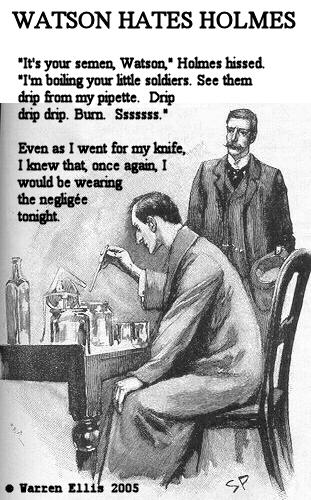


As the deestalker cap on my bookshelf attests, been a fan of Holmes for ages.
These are brilliant.
From the demented mind of Warren Ellis.
Definitions
Warren Ellis:
Magic is science. I've always understood it as a set of tools with which to enter into conversation with the dark matter of your own brain and whatever that is (un)wired to.
Ritual is set and setting: cues to induce a state of mind. Exactly the environment and intent created for the early Western psychedelic experiences of the 20th century...
Unschooling
"I am beginning to suspect all elaborate and special systems of education. They seem to me to be built upon the supposition that every child is a kind of idiot who must be taught to think. Whereas, if the child is left to himself, he will think more and better, if less showily. Let him go and come freely, let him touch real things and combine his impressions for himself, instead of sitting indoors at a little round table, while a sweet-voiced teacher suggests that he build a stone wall with his wooden blocks, or make a rainbow out of strips of coloured paper, or plant straw trees in bead flower-pots. Such teaching fills the mind with artificial associations that must be got rid of, before the child can develop independent ideas out of actual experience."-- Anne Sullivan
http://www.unschooling.com/
Subscribe to:
Posts (Atom)