
Thursday, October 06, 2016


Training - “I’ll do the best I can do today with whatever is going on.”
10/5 - press, chins, dips, face pulls, pushdowns
10/4 - shadowbox, stretch
10/3 - squats, leg raise, lunge
9/30 - bench, chins, pushups
How a 330 lb High School Dropout Lost 140 and Turned His Life Around | Nerd Fitness: "I used to say, “Oh, I’ll start again tomorrow. So, I may as well just eat my face off today.” I did that for literally years. I’m not kidding. YEARS. Every day!
I mean, it’s basically insanity. Doing the same thing and expecting different results.
It’s like I lived the same day every day in some ways like Groundhog Day. I even made several different NF accounts over the years because I’d ‘want to start fresh’. It’s basically like deleting your saved game and starting over and expecting that somehow you’ll make it further the next time because you wished you were a chaotic neutral dwarf, not a chaotic neutral Halfling.
Changing your mindset and attitude is hard. Now I think, “I’ll do the best I can do today with whatever is going on.” If I go out drinking at eat a little too much, I might gain a 1/4th to ½ pound of actual fat. But I know it’ll come off in a week.
I don’t define myself by my mistakes, but my success. And I let myself be human."

Seven Years Primal: Healthier, Stronger, and Wiser Than Ever | Mark's Daily Apple: "Testosterone is a hell of a drug. You’ve been deficient in it your entire life. Your inability to grow a beard is not genetic. I’m sorry to say your serum levels are within the upper limit of normalcy for women. Your crippling social anxiety is not because you are a nerd per se, but because you lack the necessary hormones for confident social behavior. Now, you are going to have to be very careful with this. As with any hormone, prolonged deficiency leads to increased sensitivity. When you start eating like an alpha hunter, and training like an alpha hunter, the androgens will blow you away. Painting your face with your own blood during a deadlift workout may seem like a great idea, and it is pretty inspired, but perhaps not advisable in the company gym. Recognize your hormones and don’t let them master you. Indeed, by controlling your hormones, you control your reaction to events, which is as good as controlling reality itself, and true sorcery."


Can't imagine why no one takes the media seriously anymore.
Or political correctness, for that matter.

"...the family that is eating together while simultaneously on their phones is not actually together. They are “alone together.” You are where your attention is."
Andrew Sullivan: My Distraction Sickness — and Yours: "By the last few months, I realized I had been engaging — like most addicts — in a form of denial. I’d long treated my online life as a supplement to my real life, an add-on, as it were. Yes, I spent many hours communicating with others as a disembodied voice, but my real life and body were still here. But then I began to realize, as my health and happiness deteriorated, that this was not a both-and kind of situation. It was either-or. Every hour I spent online was not spent in the physical world. Every minute I was engrossed in a virtual interaction I was not involved in a human encounter. Every second absorbed in some trivia was a second less for any form of reflection, or calm, or spirituality. “Multitasking” was a mirage. This was a zero-sum question. I either lived as a voice online or I lived as a human being in the world that humans had lived in since the beginning of time...
We all understand the joys of our always-wired world — the connections, the validations, the laughs, the porn, the info. I don’t want to deny any of them here. But we are only beginning to get our minds around the costs, if we are even prepared to accept that there are costs. For the subtle snare of this new technology is that it lulls us into the belief that there are no downsides. It’s all just more of everything. Online life is simply layered on top of offline life. We can meet in person and text beforehand. We can eat together while checking our feeds. We can transform life into what the writer Sherry Turkle refers to as “life-mix.” But of course, as I had discovered in my blogging years, the family that is eating together while simultaneously on their phones is not actually together. They are, in Turkle’s formulation, “alone together.” You are where your attention is. If you’re watching a football game with your son while also texting a friend, you’re not fully with your child — and he knows it. Truly being with another person means being experientially with them, picking up countless tiny signals from the eyes and voice and body language and context, and reacting, often unconsciously, to every nuance. These are our deepest social skills, which have been honed through the aeons. They are what make us distinctively human...
Has our enslavement to dopamine — to the instant hits of validation that come with a well-crafted tweet or Snapchat streak — made us happier? I suspect it has simply made us less unhappy, or rather less aware of our unhappiness, and that our phones are merely new and powerful antidepressants of a non-pharmaceutical variety. In an essay on contemplation, the Christian writer Alan Jacobs recently commended the comedian Louis C.K. for withholding smartphones from his children. On the Conan O’Brien show, C.K. explained why: “You need to build an ability to just be yourself and not be doing something. That’s what the phones are taking away,” he said. “Underneath in your life there’s that thing … that forever empty … that knowledge that it’s all for nothing and you’re alone … That’s why we text and drive … because we don’t want to be alone for a second.”"

We all understand the joys of our always-wired world — the connections, the validations, the laughs, the porn, the info. I don’t want to deny any of them here. But we are only beginning to get our minds around the costs, if we are even prepared to accept that there are costs. For the subtle snare of this new technology is that it lulls us into the belief that there are no downsides. It’s all just more of everything. Online life is simply layered on top of offline life. We can meet in person and text beforehand. We can eat together while checking our feeds. We can transform life into what the writer Sherry Turkle refers to as “life-mix.” But of course, as I had discovered in my blogging years, the family that is eating together while simultaneously on their phones is not actually together. They are, in Turkle’s formulation, “alone together.” You are where your attention is. If you’re watching a football game with your son while also texting a friend, you’re not fully with your child — and he knows it. Truly being with another person means being experientially with them, picking up countless tiny signals from the eyes and voice and body language and context, and reacting, often unconsciously, to every nuance. These are our deepest social skills, which have been honed through the aeons. They are what make us distinctively human...
Has our enslavement to dopamine — to the instant hits of validation that come with a well-crafted tweet or Snapchat streak — made us happier? I suspect it has simply made us less unhappy, or rather less aware of our unhappiness, and that our phones are merely new and powerful antidepressants of a non-pharmaceutical variety. In an essay on contemplation, the Christian writer Alan Jacobs recently commended the comedian Louis C.K. for withholding smartphones from his children. On the Conan O’Brien show, C.K. explained why: “You need to build an ability to just be yourself and not be doing something. That’s what the phones are taking away,” he said. “Underneath in your life there’s that thing … that forever empty … that knowledge that it’s all for nothing and you’re alone … That’s why we text and drive … because we don’t want to be alone for a second.”"

"Funny business, this living."
I, too, simultaneously have strong opinions yet "don't really know what I am anymore."
Alton Brown, Showman of Food TV, Pulls Back the Curtain - The New York Times: "Although Mr. Brown often assumes he is the weakest link in any chain, he holds strong opinions. A question about why he makes barbecued potato chips by smoking potato slices over wood chips on the stove when they sell perfectly good barbecue chips at the store propels him into a monologue on the state of hospitality in America.
“I’m going to make you these chips,” he said. “You’re going to eat them and say, ‘Thank you.’ The time we spent together making them is a valuable piece of the hospitality equation. The taking in that equation is even more important than the giving. But here in this country, we have decided to replace ‘thank you’ a great deal with ‘I can’t eat that.’”
 When he’s on a roll like this, it’s best to let him keep going.
“Unless you have a medical bracelet that says celiac, shut up and eat the food,” he said. “We want to be so special. We not only want to be special for our cooking, we want to be special for our eating. There are times when vegetarians should shut up and eat the pork chop.”
Still, for all his forcefulness and clarity on any number of topics, Mr. Brown seems to be seeking clarity on matters more internal. “I’m not where I thought would be at this point in my life,” he said, “but I’m wiser by a long shot.” Still, he said, taking another sip of sangria, “I don’t really know what I am anymore.”
Then he got up off the porch swing and headed back to his kitchen.
“Funny business,” he said, “this living.”"
When he’s on a roll like this, it’s best to let him keep going.
“Unless you have a medical bracelet that says celiac, shut up and eat the food,” he said. “We want to be so special. We not only want to be special for our cooking, we want to be special for our eating. There are times when vegetarians should shut up and eat the pork chop.”
Still, for all his forcefulness and clarity on any number of topics, Mr. Brown seems to be seeking clarity on matters more internal. “I’m not where I thought would be at this point in my life,” he said, “but I’m wiser by a long shot.” Still, he said, taking another sip of sangria, “I don’t really know what I am anymore.”
Then he got up off the porch swing and headed back to his kitchen.
“Funny business,” he said, “this living.”"


"There are now 55 declared no-go zones in Sweden."
"It's a little more hostile than I had anticipated... To be honest we hadn't anticipated such intense aggression."
You don't say? Mass migration from a disparate culture into an overburdened and overtaxed state. What could go wrong?
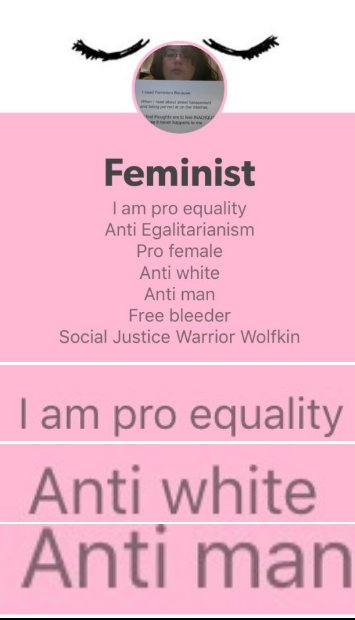
"You don't need to hurt us."

You are not, in fact, a wolf.
Look, if you're not hurting anybody, have at it. But trying to mainstream and normalize these ideas or pretending this isn't some odd little niche that - no, is never going to widely lauded, accepted or not thought strange - just ignores vast swaths of reality and human behavior.

Wednesday, September 28, 2016


Training.
9/28 - deadlifts, situps, backxt, bridge
9/27 - stretch
9/26 - press, chins, dips
9/25 - stretch
9/24 - stretch
9/23 - squats, leg raise, stretch


9/27 - stretch
9/26 - press, chins, dips
9/25 - stretch
9/24 - stretch
9/23 - squats, leg raise, stretch
Tammy Hembrow shares fitness tips on regaining pre-baby body | Daily Mail Online: "A mother-of-two who went from heavily pregnant to svelte within two months has posted incredible pictures of her transformation. Fitness guru Tammy Hembrow, from Queensland, shared the photos with her four million Instagram followers as she paid homage to the 'incredible power' of the human body. The photos show how she turned her baby bump into a taut tummy with a dedicated regime of diet and exercise."


"Show me a man or woman that is 100 pounds overweight who says they love their body and I will show you a liar."
 People deserve compassion and love. Bad ideas, like "fat acceptance," deserve the harshest criticism you're able to give.
The Real “Body Love” – MAX SHANK: "Body Love is the latest hot topic to hit the fitness industry.
I like the idea, really I do.
However, I have seen this idea portrayed in two ways.The first, which I like, is about not striving for the myth of perfection. The second, which I don’t, is about excusing people who completely disrespect their bodies with what they do.
Show me a man or woman that is 100 pounds overweight who says they love their body and I will show you a liar. This is a classic example of people saying one thing and doing another. It’s fairly similar to a husband who beats his wife but says, “I love you.”
Imagine you spend your day eating garbage and sitting on your ass and then look in the mirror and say, “I love you.” What is the real message? Instead, show your love by how much of your time and energy you are willing to dedicate to the continued health of your body and mind. If you really love your body, give it your time and care...
When I see a person who is 100 pounds overweight giving speeches about body love at colleges, It makes me shake my head, and wonder what the world is coming to. Whether you are in the shape of your life, or just starting out on a fitness journey from a long hiatus, it really doesn’t matter. What matters, are your actions. What do you do every day that slowly kills you, or helps you thrive and grow? With your body, it’s exactly the same damn thing, you don’t love your body if you treat it like (and fill it with) garbage. In a certain sense, body love isn’t about “mindset” at all. It’s about what you do–actions speak much, much louder than words. If I have a point to make, it is this: We all have a body They all look different Be happy with what you got Try to get a little better every day Get some skills, and become more ninja-like I am 100% behind body love. Let’s be sure it lifts us up emotionally and psychologically without tearing us down physically."



Jessie Graff = Awesome.
What Regular People Can Learn From a Stuntwoman and Ninja Warrior: "Jessie Graff’s perspective:
It’s not about “staying in shape”
It’s about being strong enough to do the stunts she needs to do
Injury prevention: “Armor” to withstand the kind of physical punishment she’s going to take doing stunts
Though I’m just beginning to learn what it means to be a role model for women, I really want to share one message: being strong doesn’t make you manly or unfeminine. It just means you can do more things. It builds confidence and self reliance and opens all kinds of pathways and opportunities.
—Jessie told the Los Angeles Times
What you can take away
Dan John has used the metaphor of muscle as “armor” in contact sports like football before. It sounds like stunts are pretty similar: Jessie needs both the kinds of exercises to prevent injury and the muscle to withstand all of the falls and throws and punishment of doing stunts in movies and TV.
There’s nothing wrong with having a perspective where you want to work out to look better. The danger is when that’s the only perspective that you have for working out. Or worse, when you use working out as a punishment for food. That’s not what working out is for.
Taking a look at Self-Determination Theory, we find people have different kinds of motivation they use for working out:
Working out as punishment for “eating bad” or “looking bad”
Working out because you feel guilty if you don’t
Working out because you value being strong, or value moving well and being able to do cool stuff, or value looking good
Working out because you’ve integrated working out with all of your values, like being strong, looking good, being a good parent, being effective at work, and so on
Working out because you enjoy movement
What we find is that the people who are the least successful at their fitness and enjoy it the least, are the ones who always use the first two.
People who are the most successful with their fitness, actually use all of them. They use the top one much less often, because they use the bottom three a lot.
I wish I could tell you that there is some magical world where you can graduate to always using enjoying movement for every workout, but research doesn’t back that up. Even pro athletes and personal trainers, sometimes workout just because they’ll feel guilty if they don’t.
Research indicates that a healthy relationship with a workout motivation is all of the above. What makes it healthy is using your values a lot of the time. The goal is to notice what you value about working out, why it matters to you.
And then, if you can find some movements or workouts you do just for the fun of it (like rock climbing or boxing!)
Bringing it back to Jessie — for her, it all comes down to being directly related to her job. A job that she clearly loves! So, you could say that all of it — from the stunt practice to the strength training to the injury prevention is all completely integrated with her values."

"Is there really a Millennial underemployment crisis? Yes, but only among liberal-arts majors."
In hindsight, picking a different major would have probably been among the alternate choices I'd have made.
 The Economic Woe of Young Liberal-Arts Majors - The Atlantic: "Since the Great Recession, a powerful and occasionally terrifying narrative about the state of recent college graduates has emerged: Many young, educated 20-somethings are languishing in the purgatory of unpaid internships. Those who have managed to find jobs earn wages whose meagerness stands in stark contrast to their student debt. Even now, seven years after the Great Recession, about half of young college graduates between the ages of 22 and 27 are said to be “underemployed”—working in a job that hasn’t historically required a college degree—including, most prototypically, that infamous caricature, the College-Educated Barista. For many years, this crisis of overeducated latte artists seemed quite real, according to research by Jaison Abel and Richard Deitz, two economists from the Federal Reserve Bank of New York...
Finally, youth underemployment, like youth unemployment, is in decline. This happy news comes with an important asterisk. A large chasm has opened between the fates of young liberal-arts majors and their peers in STEM (science, tech, engineering, and math) fields. The former are struggling to find work that pays, at least before their late twenties. The latter are mostly finding lucrative work after they graduate...
Indeed, the gap between humanities and STEM students is striking. Underemployment afflicts more than 50 percent of majors in the performing arts, anthropology, art history, history, communications, political science, sociology, philosophy, psychology, and international affairs. But the undergraduate majors that promise the best shot at a high-paying job all have one word in common: engineering. Civil-, mechanical-, aerospace-, and industrial-engineering majors all have extremely low underemployment percentage and they are the least likely of all majors to land their degree-holders in a low-paying, low-skilled service sector job. “Our work does suggest that certain skills have a higher demand relative to supply than others—such as those majors related to the STEM fields and healthcare,” the authors write. "


"...we measure our worth not by the results we achieve, but by how much of our time we spend doing."
The Cult of Busyness as a means of validating the self. BBC - Future - Why you feel busy all the time (when you’re actually not): "You might assume the explanation was straightforward: we feel so much busier these days because we’ve got so much more to do. But you’d be wrong. The total time people are working – whether paid or otherwise – has not increased in Europe or North America in recent decades. Modern parents who worry they’re spending insufficient time with their children spend significantly more of it than those in generations past. “The headline changes over the last 50 years are that women do a whole lot less unpaid work, and a whole lot more paid work, and men do quite a bit less paid work, and a whole lot more unpaid work,” says Jonathan Gershuny, of the Centre for Time Use Research at Oxford University. But “the total amounts of work are pretty much exactly the same.” What’s more, the data also shows that the people who say they’re the busiest generally aren’t...
There are always more incoming emails, more meetings, more things to read, more ideas to follow up – and digital mobile technology means you can easily crank through a few more to-do list items at home, or on holiday, or at the gym. The result, inevitably, is feeling overwhelmed: we’re each finite human beings, with finite energy and abilities, attempting to get through an infinite amount. We feel a social pressure to “do it all”, at work and at home, but that’s not just really difficult; it’s a mathematical impossibility...
 With that kind of time pressure weighing us down, it’s hardly surprising that we live with one eye on the clock. But psychological research demonstrates that this kind of time-awareness actually leads to worse performance (not to mention reduced levels of compassion). So the ironic consequence of the “busy feeling” is that we handle our to-do lists less well than if we weren’t so rushed.
The economist Sendhil Mullainathan and the behavioural scientist Eldar Shafir describe this as a problem of “cognitive bandwidth”: feelings of scarcity, whether money or time, prey on the mind, thereby impairing decision-making. When you’re busy, you’re more likely to make poor time-management choices – taking on commitments you can’t handle, or prioritising trifling tasks over crucial ones. A vicious spiral kicks in: your feelings of busyness leave you even busier than before. Arguably worst of all, this mindset spreads to infect our leisure time – so that even when life finally does permit an hour or two for recuperation, we end up feeling like that ought to be spent “productively”, too. “The most pernicious thing [is] this tendency we have to apply productivity to realms of life that should, by their very nature, be devoid of that criterion,” argues Maria Popova, who runs the popular ideas blog Brain Pickings. She watched it happen with one of her own hobbies: photography. “In my past life, I walked around everywhere with a professional camera,” she says. “But now the sharing” – the idea that the reason for taking photos is to post them on Facebook or Instagram – “has become its own burden.”
If there’s a solution to the busyness epidemic, other than the universal enforcement of a 21-hour workweek – it may lie in clearly perceiving just how irrational our attitudes have become. Historically, the ultimate symbol of wealth, achievement and social superiority was the freedom not to work: the true badge of honour, as the 19th Century economist Thorstein Veblen put it, was leisure. Now, it’s busyness that has become the indicator of high status. “The best-off in our society are often very busy, and have to be,” says Gershuny. “You ask me, am I busy, and I tell you: ‘Yes, of course I’m busy – because I’m an important person!’
...we measure our worth not by the results we achieve, but by how much of our time we spend doing. We live frenetic lives, at least in part, because it makes us feel good about ourselves. To put it mildly, this makes no sense. Perhaps we’d pause long enough to realise that – if we weren’t so damn busy."
Subscribe to:
Posts (Atom)